
Wikipedia Didn’t Fight AI. They Monetized the Inevitable.
Wikipedia Didn’t Fight AI. They Monetized the Inevitable Wikipedia’s recent decision to charge AI companies for enterprise access to its content is more than just a news story. It is a case study in system design, sustainability, and strategic adaptation.
Dominique Galbraith
2/13/20262 min read
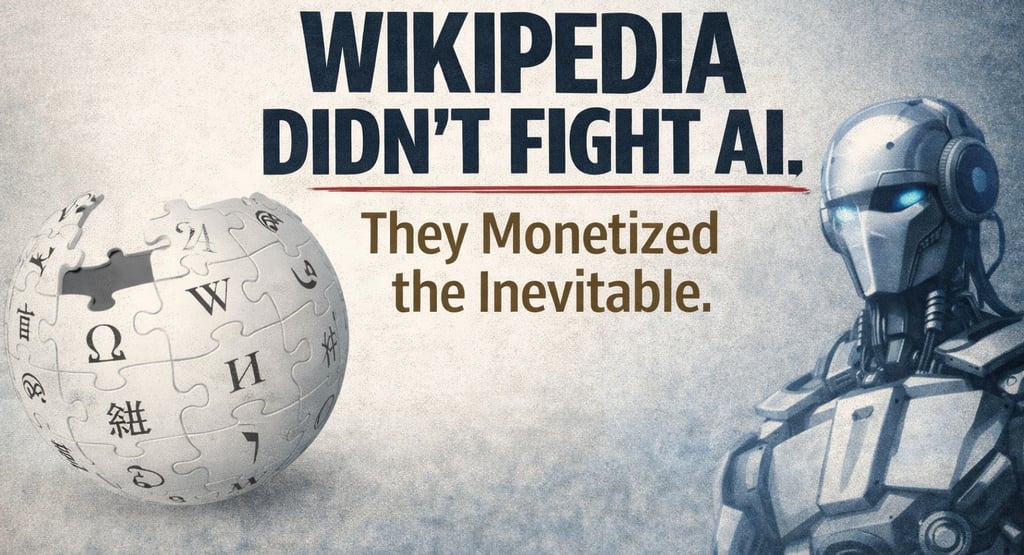
Wikipedia’s recent decision to charge AI companies for enterprise access to its content is more than just a news story. It is a case study in system design, sustainability, and strategic adaptation.
The Shift in Information Consumption
For decades, Wikipedia has been one of the most freely accessible sources of information in the world. Anyone could use it: humans, search engines, developers, and eventually, large language models.
With the rise of AI tools like ChatGPT, human traffic to Wikipedia declined. People still relied on its information, but they consumed it through AI interfaces rather than visiting the website directly.
At the same time, AI companies were extracting massive volumes of content to train their models. This activity generated significant infrastructure costs—server load, bandwidth, and maintenance—without providing direct financial support to the nonprofit organization.
A Choice Between Resistance and Adaptation
Wikipedia had several options:
Resist by suing AI companies for scraping content.
Block automated access to the site.
Attempt to recapture lost traffic with additional marketing and outreach.
All of these options would have been defensive, expensive, and likely temporary.
Instead, Wikipedia chose a different path: they adapted.
Monetizing the Inevitable
Wikipedia did not put up a paywall for the public. Access for individual users remained free. What changed was the system for high-volume, enterprise-level access.
AI companies now pay for structured access to Wikipedia content, transforming passive value extraction into active value exchange.
This approach:
Reduces infrastructure strain.
Generates revenue to sustain the organization.
Preserves the core mission of providing free knowledge to the public.
Lessons for Businesses and Systems
Wikipedia’s move illustrates a broader lesson for businesses: strong systems adapt to new behavior rather than trying to preserve outdated models.
Not all users interact with your system the same way. Some consume lightly, others extract enormous value at scale. Treating these users identically is rarely sustainable.
By recognizing the shift and designing a system around it, Wikipedia aligned value creation with value capture. They did not abandon generosity or mission—they designed a system that could endure alongside the new reality.
Key Takeaways
Sustainability is about intentional system design, not just revenue.
Free access does not mean fragile; open systems can coexist with monetization strategies.
When behavior shifts, the goal is to redesign the system, not resist change.
Conclusion
Wikipedia chose not to fight AI. They chose to monetize the inevitable.
This is a lesson in stewardship, strategic foresight, and system resilience. For businesses, platforms, and organizations, it is a reminder that adapting your system to new realities is often more powerful than resisting them.
If your system is starting to strain as demand shifts, it may not be a marketing problem. It may be a systems problem.
I help founders and operators design systems that align value creation, sustainability, and mission without compromise. Learn more at systemsbydbf.com.
Systems by DBF 2026 All Rights Reserved.